
Neurostimulation Reveals Prefrontal Cortex Plays a Central Role in Endogenous but NOT Exogenous Attention
Experiment: Psychophysics + TMS
Collaborators: Hsing-hao Lee, Antonio Fernández, PhD, Nina M. Hanning, PhD, Marisa Carrasco, PhD
📍This project aimed to probe neural correlates of human covert exogenous attention with adoption of non-invasice neurostimulation technique.
Abstract
Covert spatial attention improves visual perception. Human neuroimaging studies have shown that partially overlapping brain regions mediate two types of covert spatial attention: exogenous, which is involuntary and transient, and endogenous, which is voluntary and sustained. Human neurostimulation studies, using transcranial magnetic stimulation (TMS) and psychophysics, have revealed that early visual areas (V1/V2) are critical for exogenous –but not for endogenous– attention, and the right frontal eye field (rFEF+, human homologue) plays a central role for endogenous attention (Fernández & Carrasco, CurrBio 2020; Fernández, Hanning & Carrasco, PNAS 2023). Here, we used a psychophysics-TMS protocol to manipulate cortical activity in rFEF+ and investigated whether this area is also critical for exogenous attention.
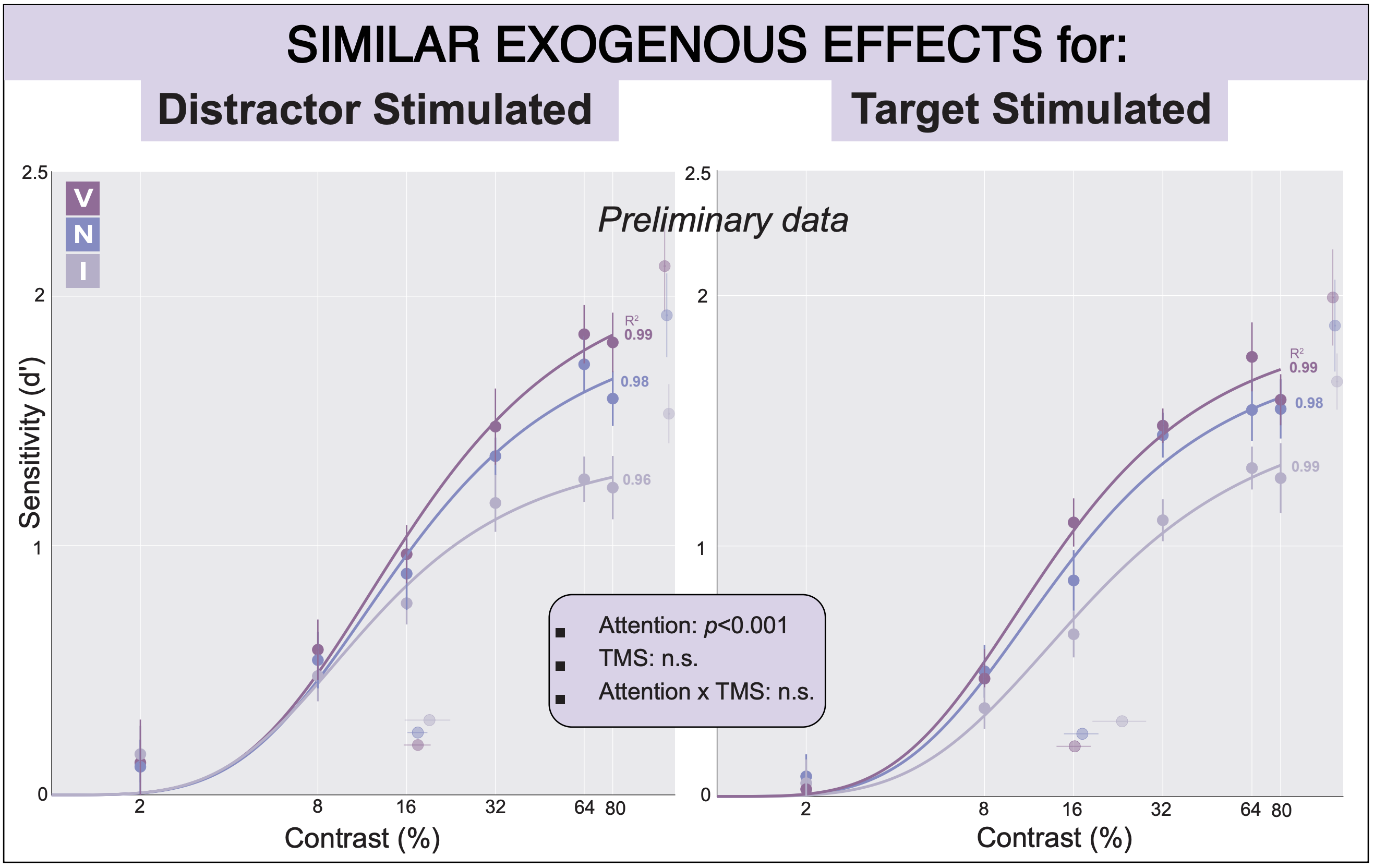
Human observers performed an orientation discrimination task. Exogenous attention was manipulated using a peripheral cue that was either valid or invalid, preceding one of two oriented Gabor patches, or a neutral cue, which preceded both Gabor patches. We applied MRI-guided double-pulse TMS to each observer’s rFEF+ during stimuli presentation, following the cues. To estimate psychometric contrast response functions (CRF), we varied stimulus contrast and analyzed sensitivity (d′) in the target-stimulated and distractor-stimulated hemifields, which were contralateral and ipsilateral to the rFEF+ stimulation, respectively.
When TMS was applied to rFEF+, in the distractor-stimulated hemifield both benefits at the attended location and costs at the unattended location emerged. This result is consistent with the established response gain in psychophysical experiments without TMS. Importantly, in the target-stimulated hemifield, both benefits and costs in response gain remained. This result contrasts the finding when TMS was applied to V1/V2 – the effects of exogenous attention remained at the distractor-stimulated location but were eliminated at the target-stimulated location.
The present results reveal that rFEF+ is not critical for exogenous attention. Thus, rFEF+ and V1/V2 play distinct roles in exogenous attention. Together with our previous findings, the current results help establish a double dissociation between exogenous and endogenous spatial attention and two cortical regions: Whereas V1/V2 play a critical role in exogenous, but not endogenous attention, rFEF+ plays a central role in endogenous, but not exogenous, attention.
Project Paper
In preperation
Conference Presentations
🧠2025SfN Poster
More Information
In preperation