
Bayesian Modeling of Perceptual Inference in Color Categorization
Experiment: Behavioral experiment + Modeling
Collaborators: Fengping (Helen) Hu, Lexin (Avery) Liang
📍This project modeled and quantified human color categorization under uncertainty with Bayesian inference.
Abstract
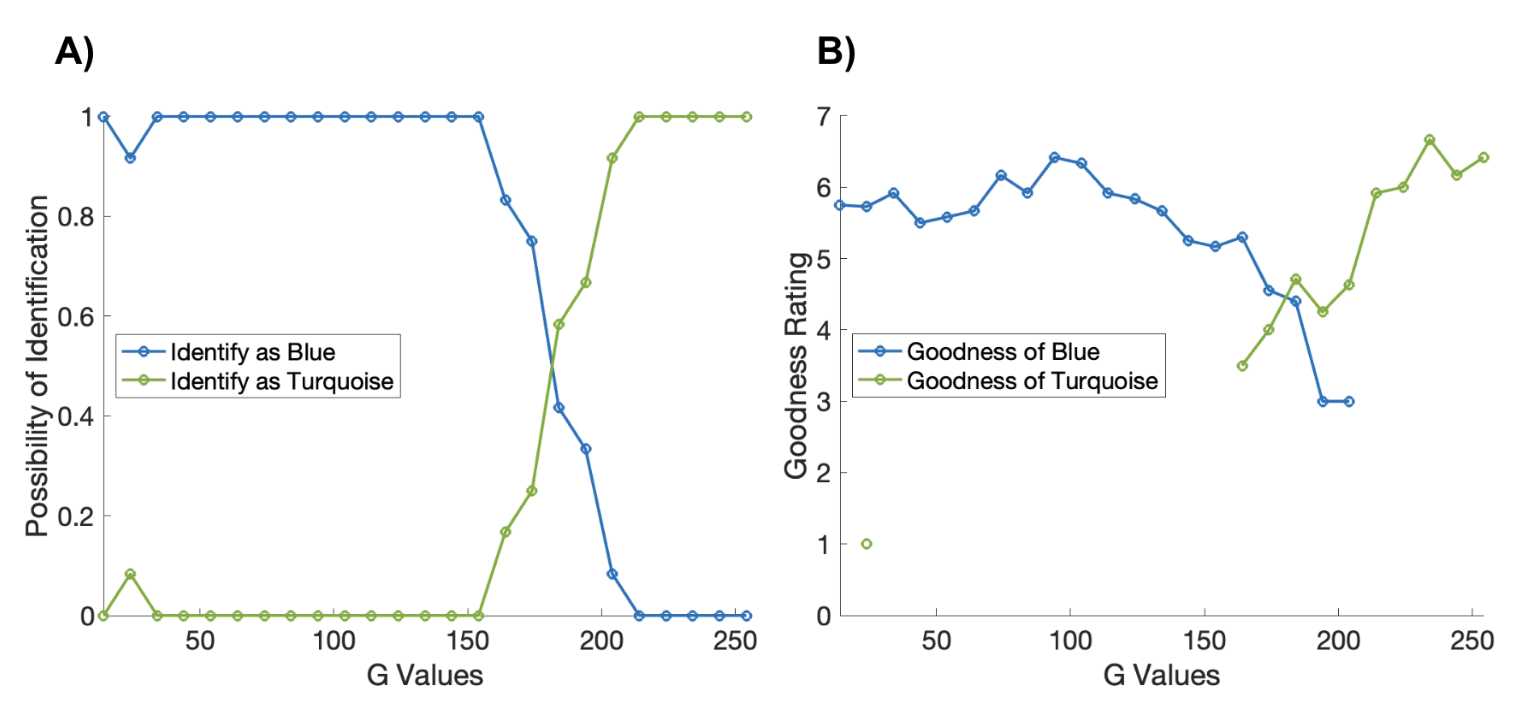
The perceptual magnet effect describes the phenomenon where the perceptual space is shrunken near an existing category, such that stimuli close to a prototype are perceived as more similar to the prototype than they actually are. This study extends the perceptual magnet effect from the well-studied domain of speech perception to color perception. We propose that, as in speech perception, the perceptual magnet effect can be explained by a Bayesian model which assumes that individuals use their knowledge of color category to optimally infer the specific shade of a color while compensating for uncertainty in the sensory signal. In two experiments, we investigated the influence of the green component (G-value) in the RGB color space on color categorization and discrimination. Our results demonstrate that the perceptual magnet effect is strongest near the centers of color categories and weakest at the category boundaries. The Bayesian model accurately predicted participants’ ratings for their perceived difference between colors, highlighting the role of category knowledge in perceptual inference. These findings suggest that the perceptual magnet effect is not limited to speech perception but can also be applied to color perception, emphasizing the generalisability of Bayesian approaches to understanding human cognition. Our study provides novel insights into the interaction between color categories and the influence of category structure on color perception.